
Precast vs cast-in-place concrete: which should you choose
Choose precast concrete when repeatability, controlled fabrication, speed of installation, or reduced on-site formwork are major priorities. Choose cast-in-place concrete when the project needs high field adaptability, monolithic placement, complex site-specific shapes, or details that are better built directly in place.
Concrete decision snapshot: Neither method is automatically better. The right choice depends on structural design, site access, schedule logic, tolerances, connection details, crane capacity, weather exposure, labor availability, and maintenance expectations.
The basic difference
Precast concrete is cast and cured away from the final installation location, usually in reusable forms, then transported and installed on site. Cast-in-place concrete is placed into formwork at the project location and hardens in its final position. Both can be used in structural and nonstructural applications, but the design and construction implications are different.
The American Cement Association's overview of cement applications describes ready mixed concrete, also known as cast-in-place or conventional concrete, as widely used because it can be placed and consolidated within formwork. The National Precast Concrete Association explains that precast concrete is prepared, cast, and cured in a controlled factory environment before being transported to the site.
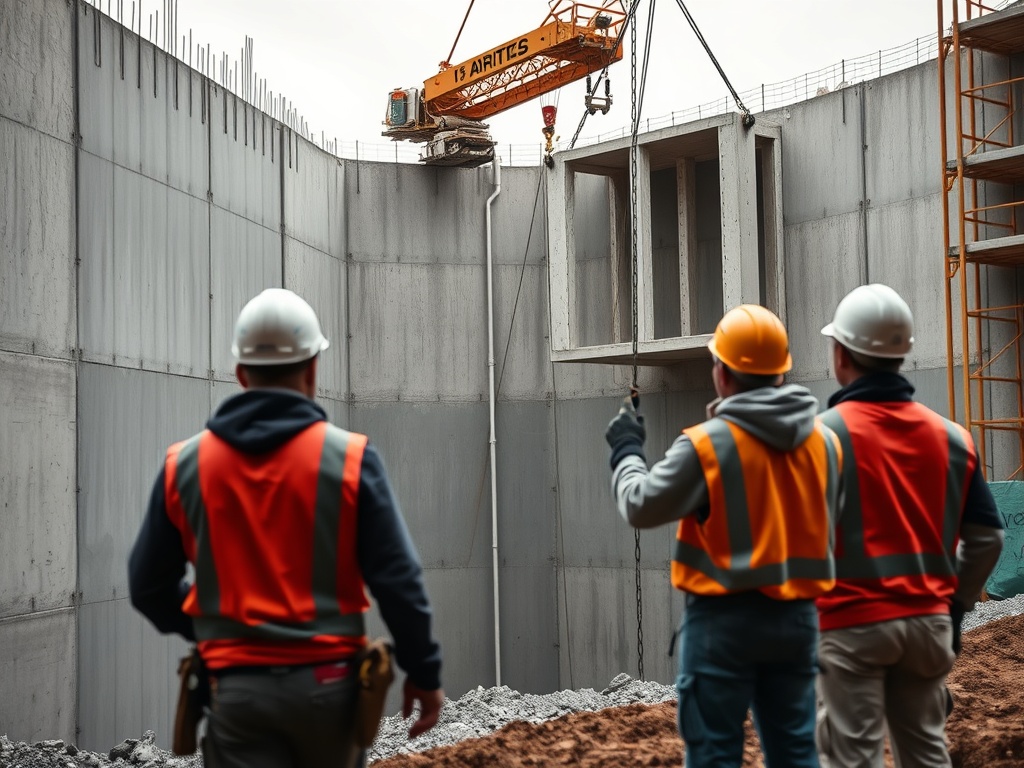
Those definitions sound simple, but the project decision is not. A precast stair, wall panel, utility vault, bridge element, facade panel, or floor plank may change logistics, crane planning, connection design, waterproofing details, and sequencing. A cast-in-place wall, slab, footing, topping, or core may change formwork needs, curing plans, field labor, and weather sensitivity.
Where precast tends to fit
Precast often fits projects with repeated shapes, constrained schedules, limited on-site labor availability, or a need to reduce certain field operations. Manufacturing in a controlled environment may support consistent production and quality-control processes, although the outcome still depends on design, fabrication, transport, storage, and installation quality.
Precast can be attractive when site access allows delivery and lifting, and when connections are well coordinated. It may also help on projects where several components can be produced while site work proceeds. For owners who operate multiple similar locations, the repeatability logic overlaps with how franchise locations standardize construction and maintenance across markets.
Where cast-in-place may fit better
Cast-in-place concrete may be preferable when the structure needs to respond to irregular site conditions, complex geometry, or details that are easier to build continuously. It can also be practical when transport routes, crane picks, staging space, or component weights make precast difficult.
Field placement gives contractors flexibility, but it introduces its own requirements: formwork, reinforcing placement, concrete delivery, consolidation, curing, testing, protection, and inspection. Architectural cast-in-place concrete can require special attention to forming, materials, placement, and finishing. The American Concrete Institute's concrete standards and specifications are a starting point for understanding the importance of consensus-based technical guidance.
Comparison table for project planning
| Decision factor | Precast concrete | Cast-in-place concrete |
|---|---|---|
| Schedule logic | Can allow off-site production while site work progresses | Depends more directly on site readiness and placement sequence |
| Site flexibility | Less forgiving after fabrication | More adaptable during field layout and forming |
| Quality control | Factory conditions may support controlled production | Field conditions require strong inspection and curing controls |
| Logistics | Needs delivery routes, pick planning, and storage space | Needs concrete supply, formwork, access, and placing crews |
| Connections | Requires coordinated embeds, tolerances, and joint details | Can create continuous elements when properly designed and placed |
| Maintenance impact | Joints and connections may need future attention | Cracking, joints, and surface protection still require maintenance planning |
This table is a planning aid, not a specification. Structural engineers, architects, contractors, and suppliers should evaluate the actual design loads, codes, exposure, material requirements, tolerances, and constructability constraints.
Think in elements, not whole projects
Many projects use both methods. A building may have cast-in-place foundations, precast stairs, cast-in-place topping slabs, precast utility structures, and site-cast equipment pads. Treating the decision as one method for the entire project can hide better combinations.
Evaluate each element by function and constraint. A repetitive wall panel may suit precast, while an irregular foundation wall may be better cast in place. A precast drainage structure may simplify site work, while a cast-in-place slab may adapt better to final dimensions. Mixed methods require careful interface details, but they can give a project more flexibility than a single blanket decision.
Hidden risks that affect the choice
The first hidden risk is tolerance. Precast components must fit with other building systems, so dimensional control, survey, embeds, connection plates, sleeves, and bearing surfaces matter. A small coordination error can become a larger installation problem.
The second risk is access. Precast may look faster on paper until the team studies delivery routes, overhead conflicts, crane reach, street restrictions, storage space, and weather exposure during lifts. Cast-in-place may appear simpler until the team studies formwork congestion, reinforcing density, concrete delivery windows, curing protection, and inspection timing.
The third risk is long-term service. A method that saves installation time but creates hard-to-access joints, drainage traps, corrosion exposure, or repair complexity may increase maintenance friction. Facility teams tracking reliability, as discussed in what MTBF and MTTR mean for facilities managers, should be included when concrete elements affect access or future repair work.
Questions to ask before selection
- Is the design repetitive enough to benefit from precast production?
- Can the site accept deliveries, staging, and crane picks safely?
- Are tolerances and connection details clearly defined?
- Will field conditions require frequent adaptation?
- How will waterproofing, sealants, joints, and drainage be maintained?
- Are local suppliers and qualified installers available?
- Does the schedule actually benefit after procurement lead times are included?
- Who is responsible for inspection, testing, and repair of defects?
Crew fatigue and overtime can also affect concrete operations, especially during shutdowns, night placements, or accelerated installation windows. The planning discipline in fatigue management for crews working shutdowns and overtime should be considered when schedule pressure drives method selection.
Choosing the concrete path with fewer surprises
The practical answer is to choose the method that best fits the project's design, site constraints, installation sequence, and maintenance needs. Precast may support speed and repeatability when coordination is strong. Cast-in-place may support adaptability and continuity when field execution is well controlled.
This article is for informational use only and does not constitute structural engineering, code, specification, or project-management advice. Concrete method selection should be reviewed by qualified professionals using applicable codes, standards, drawings, specifications, and local conditions.
A useful next step is to build a one-page method comparison for the specific concrete element, not for the whole project, and review it with design, field, supplier, and maintenance stakeholders.